19 Oct, 2026 | 28 Views | Apple Insulated Wires
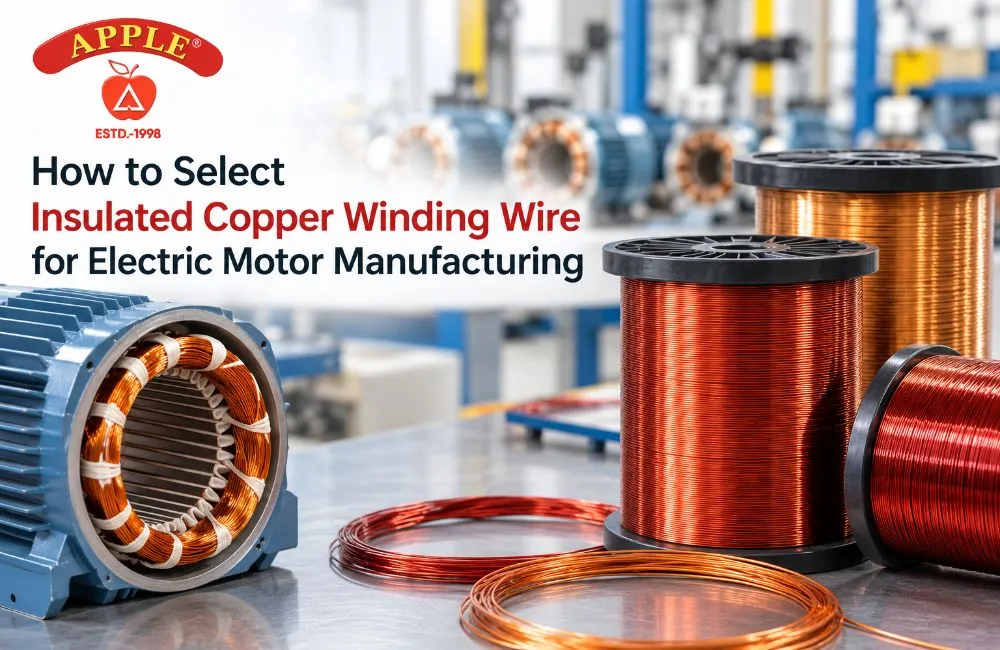
How to Select Insulated Copper Winding Wire for Electric Motor Manufacturing
An electric motor may look like a simple piece of industrial equipment, but its performance depends on several carefully selected components. One of the most important is the winding wire. The right insulated copper winding wire helps maintain electrical performance, supports efficient heat management and protects motor windings against electrical faults.
For electric motor manufacturers, selecting winding wire is not simply about choosing a copper conductor of the required diameter. Factors such as insulation thickness, thermal endurance, winding technique, mechanical strength and operating conditions all influence the final choice.
Whether you manufacture industrial motors, submersible pumps or specialized electrical equipment, understanding these factors can help you select copper winding wire that suits your motor design and production requirements.
Start with the Motor Design and Application
The first step in selecting copper wire for motor winding is understanding how the motor will operate.
Different motors have different electrical and mechanical requirements. A small domestic motor may operate under different conditions from an industrial motor designed for continuous operation.
Before selecting winding wire, consider:
-
Motor power rating and voltage requirements
-
Operating temperature and duty cycle
-
Winding configuration and slot dimensions
-
Current-carrying requirements
-
Operating environment and exposure to moisture or chemicals
For example, submersible pump motors require winding insulation suitable for their specific operating environment, while industrial motors may need insulation systems designed for demanding thermal and mechanical conditions.
Starting with the motor's design specifications helps narrow down the appropriate wire options.
Select the Correct Copper Conductor Diameter
The diameter of copper winding wire directly influences its electrical resistance and the amount of current it can carry under specified operating conditions.
A wire with an unsuitable diameter can create problems during motor manufacturing. An undersized conductor may result in excessive electrical losses and heating, while an oversized conductor may not fit properly within the available winding slots.
Motor manufacturers should consider:
-
Required conductor cross-sectional area
-
Electrical resistance
-
Current density
-
Available winding space
-
Number of turns required in the coil
The conductor diameter should always be selected according to the motor's electrical design rather than estimated solely from its physical appearance.
Choose an Insulation System That Matches Operating Conditions
Insulation is what makes insulated copper winding wire suitable for electrical winding applications. It creates an insulating barrier between adjacent turns and helps prevent short circuits.
Different insulation materials offer different thermal, mechanical and electrical properties.
Common insulation systems include:
Polyester-based insulation: Used in winding applications where the required electrical and thermal performance is compatible with the material specifications.
Polyesterimide insulation: Suitable for applications requiring higher thermal endurance than conventional lower-temperature insulation systems.
Polyamide-imide overcoating: Often used as an additional coating to improve properties such as abrasion resistance and thermal performance, depending on the complete insulation system.
Polyurethane insulation: Used in applications where solderability is required, subject to the specific product grade.
The right insulation system depends on motor construction, manufacturing processes and operating conditions.
Understand Thermal Classes Before Making a Selection
Temperature is an important consideration in electric motor manufacturing. During operation, motors generate heat through electrical and mechanical losses. The winding insulation must withstand the thermal conditions for which the motor is designed.
Copper winding wire is available in different thermal classes, including:
|
Thermal Class |
Temperature Index |
|
Class 130 |
130°C |
|
Class 155 |
155°C |
|
Class 180 |
180°C |
|
Class 200 |
200°C |
These classifications indicate the thermal endurance associated with the insulation system under applicable testing standards. They should not be treated as guaranteed continuous operating temperatures for the complete motor.
Selecting a suitable thermal class requires considering the motor's temperature rise, cooling arrangement, duty cycle and insulation system compatibility.
Consider the Winding Process and Mechanical Requirements
A winding wire must perform well not only inside the finished motor but also throughout the manufacturing process.
During coil winding, copper wire experiences bending, tension, friction and contact with winding equipment. If the insulation is not suitable for these conditions, it may become damaged during production.
Consider the following requirements:
-
Flexibility: The conductor should accommodate the bending requirements of the winding design.
-
Abrasion resistance: The insulation should withstand the mechanical contact involved in winding.
-
Adhesion: The enamel coating should remain properly bonded to the copper conductor.
-
Dimensional consistency: Uniform wire dimensions help maintain predictable winding operations.
These properties become particularly important in automated motor winding processes, where consistent wire performance supports smoother production.
Check Compatibility with Varnishes and Impregnation Materials
Motor windings are often treated with insulating varnishes or resin systems to improve mechanical stability and electrical insulation.
However, not every enamel insulation system is compatible with every varnish, resin or curing process.
Before finalizing a winding wire, manufacturers should verify:
-
Compatibility with the selected impregnation material
-
Resistance to the curing temperature
-
Adhesion and bonding characteristics
-
Chemical compatibility with the operating environment
Testing compatibility before full-scale production can help prevent insulation deterioration and manufacturing issues.
Evaluate Wire Quality Through Technical Testing
Product specifications provide useful information, but actual testing is equally important when selecting winding wire.
Motor manufacturers should review relevant quality parameters, including:
|
Quality Parameter |
Why It Matters |
|
Conductor diameter |
Maintains dimensional accuracy |
|
Electrical resistance |
Helps verify conductor consistency |
|
Insulation breakdown voltage |
Evaluates dielectric performance |
|
Elongation |
Indicates mechanical flexibility |
|
Abrasion resistance |
Assesses coating durability |
|
Heat shock resistance |
Evaluates insulation performance under thermal stress |
Testing requirements should follow the applicable product standards and agreed technical specifications. Requesting product datasheets and relevant test reports from the manufacturer can make supplier evaluation more reliable.
Why the Right Winding Wire Manufacturer Matters
Selecting the right copper winding wire is only one part of successful motor production. Consistent product specifications, dependable supply and technical understanding are equally important when sourcing materials for regular manufacturing requirements.
Apple Insulated Wires Pvt. Ltd. offers copper winding wire solutions for different electrical and industrial applications. Its product range includes copper winding wires in thermal classes 130, 155, 180 and 200, along with different insulation systems such as modified polyester, dual-coated PEI+PAI and polyurethane self-solderable options.
These product variations allow manufacturers to explore winding wire options according to their application-specific requirements.
For motor manufacturers and OEMs, discussing conductor dimensions, insulation requirements and operating conditions with an experienced manufacturer can help identify a suitable product.
Conclusion
Selecting the right insulated copper winding wire requires a clear understanding of motor design, conductor dimensions, insulation properties, thermal requirements and manufacturing processes. A carefully selected wire can support consistent winding operations and reliable electrical performance.
For motor manufacturers looking for application-specific copper winding wire solutions, choosing a manufacturer with a suitable product range and technical knowledge is an important step.
Need copper winding wire for your motor manufacturing requirements? Contact Apple Insulated Wires to discuss your specifications, explore available insulation systems and find a suitable solution for your application.
Visit www.applewires.com to explore the product range and submit your enquiry.